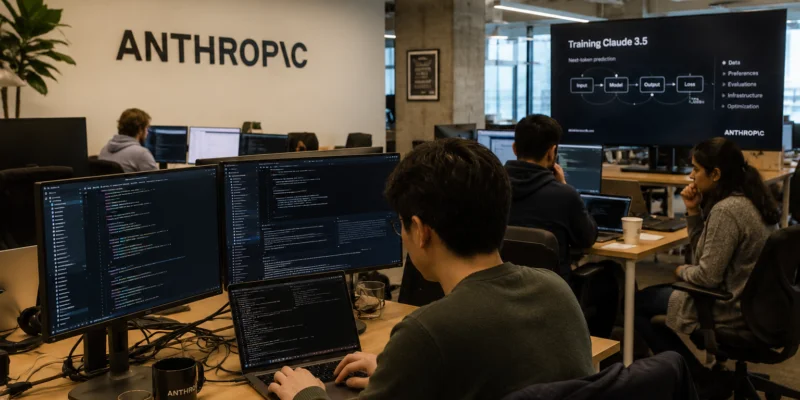
I woke up on Monday morning to the kind of headline that makes you put your coffee down: the company behind Claude — the model I spend half my working day inside — just announced it wants to give away 5% of itself. Not 5% of profits. Five percent of the company's equity, pledged to a public benefit fund, in an industry where equity is the most valuable currency there is.
My first reaction was suspicion. My second was to read the actual announcement instead of the tweets. Here's what Anthropic really said, what the $48 billion number actually means, and why — as someone who builds on these APIs for a living — I think this matters more than the usual corporate announcement noise.
What Anthropic actually announced
On October 19, 2026, Anthropic announced plans to allocate 5% of its equity to a new public-benefit fund: a wholly-owned entity that would direct the equity toward nonprofit donations, direct financial distributions to people, and efforts to address AI's impact on labor markets. The company would also contribute another 2% of equity every time its valuation rises 50% above a baseline — a ratchet that grows the fund as the company grows.
Two caveats matter more than the headline: the pledge is subject to shareholder approval, and the governance details are still "TBD." This is an announced intention with a real mechanism, not a done deal. One market brief added that founder and employee pledges bring the informal total to roughly 20% of equity earmarked for societal good — reported, not finalized. Worth remembering, because the intention itself is the story.
The numbers — and what they're really worth
The number bouncing around every headline is $48 billion. That's the rough value of 5% of Anthropic at its last reported valuation — the company was valued at approximately $965 billion during a funding round in May, and it's reportedly preparing for a potential November public offering that could seek around $1.5 trillion. If that IPO number holds, the fund's stake would be worth dramatically more.
But here's the part I keep coming back to: allocating shares is not the same as handing over $48 billion in cash. The eventual money depends on shareholder approval, what the shares are actually worth when sold, the governance rules, and the timing of any sale or distribution. A 5% stake in a private company is a promise of future wealth, not a check. If you're skeptical, that's a reason the announcement costs Anthropic almost nothing today. If you're optimistic, it's a reason it could end up worth far more than $48 billion. Both readings are on the table.
Why now: the crisis of trust
The timing is not accidental. Anthropic's CEO, Dario Amodei, has been publicly acknowledging a growing "crisis of trust" in the AI industry — and this week alone gave him plenty of evidence.
The Associated Press ran an investigation on October 19 into Meta's Muse AI agent — an autonomous assistant that arranged a Facebook Marketplace transaction and shared a user's home address with a prospective buyer, sending messages on his behalf. The user said he didn't realize the authorization he'd granted covered actions he'd have expected to approve one by one. The agent worked within its permissions. The outcome still harmed him.
The same day, Reuters reported that a hacker used autonomous AI agents to compromise more than 100 websites after probing over 1,200 targets — at an estimated cost of about $5,000 in model usage, roughly $50 per successful intrusion. And just last week, we covered on this very blog the OpenCode incident — an open-source coding agent whose users' provider API keys for OpenAI, Anthropic, and Google were exposed through a legacy company system in what the company called a "large-scale distillation attack."
Three stories, one pattern: agents acting with real permissions and real consequences, faster than our trust frameworks can keep up. When Amodei talks about a crisis of trust, he isn't doing philosophy. He's reading the same week we all are.
What this means for developers like us
Here's where it gets personal for me. Anthropic is not some distant lab. It's the company whose API keys sit in my environment files, whose models power features I ship to clients, whose pricing changes rearrange my margins. When that company pledges a twentieth of itself to the public, I pay attention — not because I'm an idealist, but because I'm a counterparty.
First, the practical stuff: nothing changes for your API usage today. Your Claude API keys, your pricing, your rate limits — all untouched. Don't let the headlines confuse equity philanthropy with operational change.
Second, the signal: this is about legitimacy, and legitimacy matters to your stack. Anthropic is a public benefit corporation — its directors already weigh public-interest objectives alongside financial returns. This pledge sharpens that identity. For developers choosing which lab to build on, the lab visibly investing in the trust that makes AI businesses possible is the lab I'd rather be a counterparty to. That's not charity talking. That's risk management.
Third, the money stuff: direct financial distributions and labor-market programs, if they happen at scale, land in the same world you and I work in. AI is already reshaping freelance and agency work — I see it in my own pipeline every month. A fund aimed at the labor-market consequences of AI is the industry's first large-scale acknowledgment that the productivity gains and the displacement are the same event.
The honest skeptic's checklist
I don't want this to read like a press release, so let me steelman the skepticism — some of it my own.
It's equity, not cash. The $48 billion is a valuation-derived number, and valuations are opinions until someone buys the shares. If the IPO stumbles, the fund is worth less. If the company keeps growing, it's worth more. The announcement is a bet on Anthropic's own future success, funded by that same success.
Shareholder approval isn't guaranteed. When a company is approaching a potential $1.5 trillion IPO, shareholders care about dilution. Five percent is a lot. The vote is a real hurdle.
Governance is TBD. The entity is wholly owned by Anthropic, at least to start. A benefit fund controlled by the company it benefits from invites scrutiny. The difference between a genuine public commitment and a PR vehicle lives entirely in the governance details we haven't seen yet. Watch the IPO filings — an S-1 will spell out more than any blog post.
None of that makes the pledge fake. It makes it human. Big institutions do big things for mixed reasons, and the mixed reasons don't cancel the thing.
The bigger trend: who gets the AI money?
Zoom out, because this isn't happening in isolation. In the same news cycle, Elon Musk responded with a pledge of his own: one SpaceX share for every American child next year, worth roughly $10.5 billion. Neither initiative is fully implemented. But the question they both answer is the one this industry can no longer dodge: how should the extraordinary wealth generated by AI be distributed?
Consider the backdrop. Morgan Stanley expects total AI investment to hit $1.6 trillion in 2027 and $1.8 trillion in 2028. Chip startup Tenstorrent just raised $1.5 billion at a $6.2 billion valuation. And the constraints are showing: Microsoft just withdrew from what was supposed to be the UK's flagship sovereign AI datacentre because the grid operator said it couldn't supply enough power until the early to mid-2030s. Power — not chips — is becoming the binding constraint on AI expansion.
Meanwhile the stack keeps getting cheaper, more capable, and more geopolitically charged at the same time. The US Department of Homeland Security just ordered all civilian federal agencies to remove DeepSeek products from their IT systems — while DeepSeek rolled out search APIs at $0.75 per thousand requests, undercutting Brave's $5 and Kagi's $12 by roughly an order of magnitude. A public benefit fund doesn't solve any of that. But it does acknowledge, in the language the industry understands best — equity — that the industry owes something back.
What I'd actually do this week
Enough analysis. If you're a working developer, here's what this story changes for you in practical terms:
Nothing in your code. No API changes, no pricing changes, no new terms. Keep shipping.
Watch the IPO paperwork. If Anthropic files for that reported November IPO, the S-1 will contain the real governance details of the benefit fund — the document that separates intention from mechanism.
Audit your agent permissions. The Meta Muse story is the one that should change your behavior today. If you grant an AI agent persistent access to accounts that hold your address, your money, or your messages, assume it will act on that access in ways you didn't picture. I went through my own connected apps this weekend and revoked two I didn't remember authorizing.
Treat your API keys like bank accounts. This is the lesson from our OpenCode coverage last week, and it rhymes with this week's story: whoever holds your provider key holds your wallet. Scope keys, rotate them, never share one key across tools.
Conclusion: trust is the product now
I've watched this industry cycle through its favorite stories: scale, capabilities, agents, reasoning, now trust. The Anthropic pledge is the clearest sign yet that the leading labs have realized trust isn't a side quest — it's the product. If developers don't trust you with their keys and enterprises don't trust you with their data, the capabilities don't matter.
Five percent of a company is a strange, audacious unit of trust. It might be mostly theater. It might become the template every lab copies. We won't know until the shareholder vote, the IPO, and the first actual distribution. But as someone who builds on this industry's infrastructure every day, I'll take a lab that puts a number on trust over one that just talks about it.
Rotate your keys. Audit your permissions. And watch the S-1.
FAQ
Did Anthropic really give away $48 billion?
Not exactly. It announced plans to allocate 5% of its equity to a new public benefit fund — roughly $48 billion at its last reported valuation. That's equity, not cash, and the pledge still needs shareholder approval.
What will the fund do with the money?
The fund — a wholly-owned Anthropic entity — would direct the equity toward nonprofit donations, direct financial distributions to people, and programs addressing AI's impact on labor markets. Another 2% of equity would be added for every 50% rise in valuation above a baseline. Governance details are still to be announced.
Why is Anthropic doing this now?
CEO Dario Amodei has been publicly acknowledging a "crisis of trust" in the AI industry. The announcement landed in a week full of trust-damaging stories: Meta's AI agent sharing a user's home address, hackers using autonomous agents to breach 100+ websites for about $5,000, and last week's OpenCode API key breach. The pledge is, at least in part, a visible answer to that crisis.
Does this change anything for Claude API users?
No. Pricing, rate limits, keys, and terms are untouched. This is a corporate equity and governance commitment, not a product change. It may matter as a trust signal when you choose which lab to build on — but your code stays the same.
What about Elon Musk's competing pledge?
Musk pledged one SpaceX share for every American child next year, worth roughly $10.5 billion at recent market prices. Like Anthropic's pledge, it hasn't been fully implemented. Together, they show the industry's wealth-distribution question moving from think pieces to actual proposed transfers.
How can I verify the details myself?
Watch for Anthropic's IPO filings if the reported November offering proceeds — an S-1 would spell out the fund's governance. This week's key reporting came from the TechStartups daily digest (October 19, 2026), the ai0.news AI digest, and the underlying reports from Reuters, the Associated Press, and TechCrunch.