I watched a car fly last night, and I still don't quite believe it
Let me be honest with you: I went into this expecting vaporware. A decade of broken Tesla promises will do that to a person. Elon Musk has been telling us the flying Roadster is coming since I had hair in different places than I do now. So when Tesla announced a "Roadster unveiling event" at the SpaceX test facility in McGregor, Texas, my first thought was: okay, another car on a stage with fog machines and a man in a black t-shirt saying "production next year."
Then the car drove upside down up a ramp.
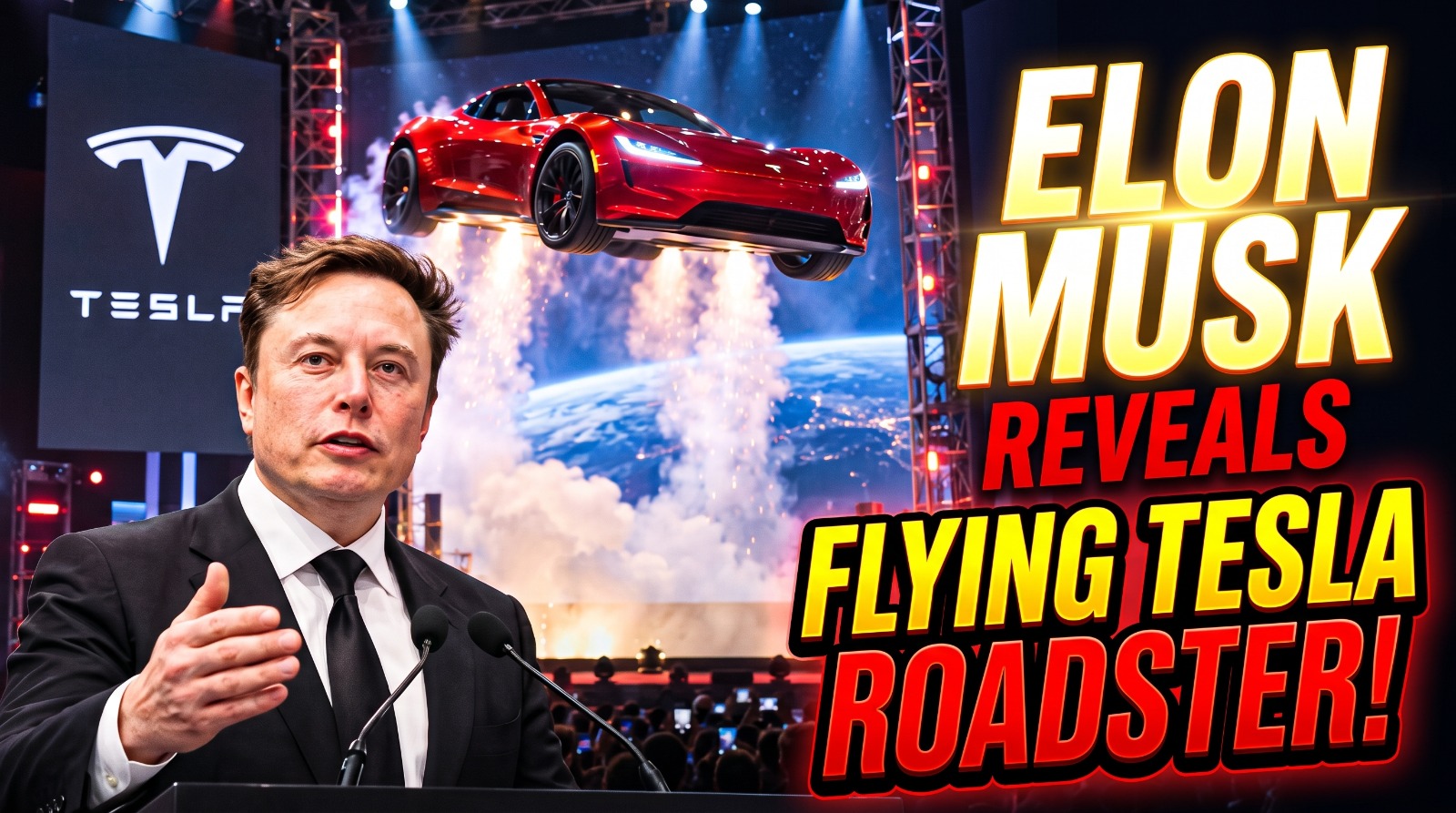
I have watched that clip maybe fourteen times now. A Tesla Roadster — a real, physical car — climbing a curved ramp upside down, stuck to it by suction, then launching off the top, flipping through the air, firing thrusters, and landing. No driver inside, because as Musk put it, "to make sure we don't kill anyone." The crowd at McGregor lost its mind. I, sitting at my desk at a deeply unreasonable hour, made a sound my neighbors are still talking about.
So. Let's talk about what actually happened on October 15, 2026 — because beneath the spectacle, there's a genuinely fascinating machine, a genuinely ridiculous timeline, and a genuinely open question about whether any of this will ever drive on a real road.
The demo, play by play
The event was held outside Waco at SpaceX's McGregor test facility, which should tell you everything about how seriously Tesla is taking the "rocket company builds a car" angle. Tesla's vehicle engineering chief Lars Moravy and designer Franz von Holzhausen were both on site, flanking Musk like proud parents.
The centerpiece was a curved ramp — part Hot Wheels track, part particle accelerator. The sequence went like this:
- Phase one: The redesigned Roadster approaches the ramp and — instead of driving up it like a sane vehicle — drives upside down along the underside of the curve, held there by a suction system. This was the "wait, what" moment. Suction strong enough to hold a car to a ceiling.
- Phase two: At the top of the arc, the car launches off the ramp, flips through the air, and fires its thrusters to stabilize and land. Cold gas thrusters. On a car.
- Phase three: For the grand finale, the Roadster leapt clean over a lineup of parked Teslas — a Cybercab, a Cybertruck, a Semi, a Model Y, and a Model 3 — like the world's most expensive game of leapfrog.
Musk, to his credit, didn't pretend this was routine. "Success is not guaranteed," he told the crowd beforehand. "If it doesn't work, we're at a safe distance." After the landing, his entire commentary was: "Well, it worked. Phew. Flying cars are real."
"Phew" is doing a lot of heavy lifting in that sentence, and honestly? I respect it. There's something disarming about the richest showman on Earth admitting he was holding his breath too.
He also told the audience to "tell people they saw it" — to prove it wasn't AI-generated. Which is a sentence that could only exist in 2026, and one I never thought I'd type about a car launch.
The tech: ten nozzles and a vacuum cleaner from the future
Okay, so how does a car fly? The short answer is: it mostly doesn't, and the long answer is where it gets interesting.
The propulsion system is a SpaceX collaboration, and it shows. The Roadster carries ultra high-pressure air tanks feeding 10 nozzles — cold gas thrusters, the same basic technology SpaceX uses for small attitude adjustments on spacecraft. Cold gas is exactly what it sounds like: no combustion, just extremely pressurized air released in controlled bursts. Simple, reliable, and — crucially — something that doesn't turn your car into a bomb.
Then there's the suction system: a fan system that generates downforce so extreme the car can cling to the underside of a ramp. This is Formula 1 fan-car territory — the Brabham BT46B and the Chaparral 2J tried this in racing fifty years ago and were banned almost immediately for being too fast. Tesla's version is apparently strong enough to hold the whole car inverted.
Tesla is offering the Roadster in three configurations, and the naming alone tells you where this is going:
Performance — 2 seats, 0–60 under 1.6s, road ready. Thrust — 2 seats, rear cold-gas thrusters, 0–60 under 0.9s, race ready. Rocket — 1 seat, perimeter thrusters, 0–60 under 0.59s, air ready.
Read that last row again. Zero to sixty in under 0.59 seconds. That's not acceleration, that's a physics violation with a warranty. The "Rocket" config has a single seat and perimeter thrusters, and Tesla labels it "air ready" — which is a phrase I would like to see on exactly one (1) car configurator page in my lifetime.
The headline numbers: 0–60 mph in less than a second (demonstrated live), a top speed of 230+ mph, and roughly 300 miles of range. The range figure is the one that makes me raise an eyebrow — cold gas thrusters eat through pressurized air at an alarming rate, so that 300 miles presumably assumes you're mostly driving like a normal person and only occasionally defying gravity.
The nine-year wait: a brief history of almost
We need to talk about the timeline, because it matters.
The second-generation Roadster was first revealed as a prototype in 2017. Tesla promised deliveries in 2020. Then 2021. Then 2022. Then the Roadster became a running joke — the car that would arrive right after the Cybertruck, which itself arrived right after several eternities.
It is now late 2026. The car still isn't in production. Musk's current target is 2028.
Now, credit where it's due: what they showed at McGregor is real hardware doing real things. This isn't a render. But I have watched Elon Musk announce production dates for nine years, and my calendar is full of scars. The Roadster has been "next year" for longer than some Tesla employees have been alive (okay, slight exaggeration, but you feel me).
And then there's the price. The 2017 quote was $200,000 for the base model. At this event? No price announced at all. Not even a range. When a car company shows you a flying car and won't tell you what it costs, the number is either "we genuinely don't know yet" or "you can't afford it and we know it." Possibly both.
The honest skepticism: it's hopping, not flying
I'm excited. I am. But I'm a developer — I think in systems, and I think in failure modes — so let me put on the other hat for a minute.
Smithsonian curator Roger Conner said what a lot of aviation people are thinking: what Tesla demonstrated is closer to "hopping" than sustained flight. And he's right. The Roadster didn't cruise through the sky; it launched, flipped, and landed. It's a ballistic maneuver with style, not a commute. Combining car structures and aircraft structures in one vehicle is, as Conner put it, a huge engineering compromise — cars are built to crash safely into things at ground level, aircraft are built to be light enough to stay up. Those two goals fight each other on every gram.
Then there's the legality question, which is the one nobody at McGregor wanted to dwell on. Are cold-gas thrusters legal on public roads? Is a suction system that can hold a car to a ceiling something your insurance company wants to hear about? What happens when your "Rocket" config Roadster's thruster startles a horse, a cyclist, or a highway patrol officer? Nobody knows, because no regulator has ever had to answer these questions before. The FAA, the NHTSA, and your local DMV are all going to have opinions, and none of them will be quick.
Musk called the Roadster "the result of what happens when you have a collaboration with the world's best car company and the world's best rocket company," and "better than any James Bond car." The James Bond line is doing marketing work, but the collaboration line is actually the most interesting thing he said — because it reframes the Roadster not as a car with rocket parts bolted on, but as a genuine hybrid discipline. Whether that discipline produces a product or a very expensive demo reel is the entire question.
What 2028 production really means
Let's do the Musk-timeline math. Announced 2017, promised 2020, demoed 2026, targeting 2028. If history is any guide, "2028" means "sometime between 2029 and the heat death of the universe, but the demo was cool."
That said — and I want to be fair here — Tesla's track record on eventually delivering absurd things is actually pretty good. The Cybertruck shipped (weird, late, but real). Full self-driving exists in a form nobody in 2016 would have believed. Starship flies. Musk's timelines are fiction; his delivery record on impossible hardware is uncomfortably real.
The 2028 target also makes engineering sense in a way the old dates didn't. Cold gas thruster packaging, the suction fan system, crash safety with pressurized tanks on board, regulatory approval for any of this — that's genuinely a two-year problem, not a "we'll figure it out" problem. The fact that they're showing working hardware rather than renders suggests the hard R&D is further along than the skeptics assumed.
My prediction, for what it's worth: limited production of the Performance config in 2028–2029 at a price well north of $200,000, Thrust as a track-only special, and the Rocket config living permanently in the "air ready" asterisk zone while lawyers and regulators have a decade-long staring contest.
My verdict
Here's where I land. The flying Roadster demo was the most genuinely surprising tech moment I've seen in years — not because flying cars are a new idea (they're one of the oldest ideas), but because someone actually built the thing and let it flip over a ramp with no driver and no safety net of CGI.
Is it a flying car? Not really — it's a very fast car that can hop, flip, and stick to ceilings. Is it the future of transportation? Almost certainly not; the physics and the regulations both say no. Is it an astonishing piece of engineering that made me feel like a kid watching a magic trick? Completely.
And maybe that's the point. Musk told the crowd to tell people they saw it, to prove it wasn't AI. In an era where half the "footage" on the internet is synthetic, there's something almost old-fashioned about a stunt you have to witness in person because no one would believe the video. The Roadster might never be practical. It might never be affordable. It might never even be legal. But last night in McGregor, Texas, a car flew — briefly, loudly, upside down — and for about ten seconds, the future felt real.
"Well, it worked. Phew."
Yeah. Phew.
Frequently asked questions
When did Elon Musk unveil the flying Tesla Roadster?
October 15, 2026, at the SpaceX test facility in McGregor, Texas, outside Waco. The demo included the car driving upside down up a curved ramp via suction, launching off, flipping mid-air with thruster stabilization, and leaping over a lineup of parked Teslas.
How does the flying Tesla Roadster work?
It uses 10 cold-gas thruster nozzles fed by ultra high-pressure air tanks (developed with SpaceX), plus a fan-based suction system that generates enough downforce to hold the car upside down. It's closer to controlled hopping and maneuvering than sustained flight.
What are the Roadster's specs?
Three configs: Performance (2 seats, 0–60 under 1.6s, road ready), Thrust (2 seats, 0–60 under 0.9s, race ready), and Rocket (1 seat, 0–60 under 0.59s, air ready). Top speed is 230+ mph with roughly 300 miles of range.
When will the Tesla Roadster be available, and how much will it cost?
Tesla targets production in 2028, but no price was announced at the event. The original 2017 quote was $200,000 for the base model — expect the flying version to cost significantly more, given the thruster hardware.
Is the flying Roadster street legal?
Unknown. The legality of cold-gas thrusters and extreme suction systems on public roads is completely untested — no regulator has ruled on it yet. The Performance config is labeled "road ready," but real-world approval will take years of regulatory work.