

I have read a lot of AI hardware announcements, and most of them blur together after the third superlative. So when a number actually stops me mid-scroll, I pay attention. This week, the number was 59.
Fifty-nine wafers. Not chips, not servers, not racks. Fifty-nine entire silicon wafers, working together, to run a single AI model. That is the answer Cerebras published on October 22, 2026, to a question every developer working with large models should be asking: what does it actually take to serve a model with three trillion parameters?
The model in question is Kimi K3, built by Moonshot AI, and Cerebras used it as a worked example in a technical post about how its wafer-scale hardware deploys trillion-parameter frontier models. I want to walk you through the math, because the math is the story — and then I want to be honest with you about what this post is not, because the caveats matter just as much.
The problem: models got bigger than memory
Let me start with the problem every inference engineer knows in their bones. A model is, at serving time, mostly weights: enormous tables of numbers the hardware has to look up for every single token it generates. When models had a few billion parameters, you could hold the whole thing on one good GPU. At three trillion, the old playbook breaks.
The reason is not compute. Modern accelerators can crunch numbers far faster than they can fetch them. The bottleneck is memory: getting the weights to the processors, over and over, for every token. This is the memory wall, and it is why serving giant models feels so expensive even when the hardware looks powerful on paper.
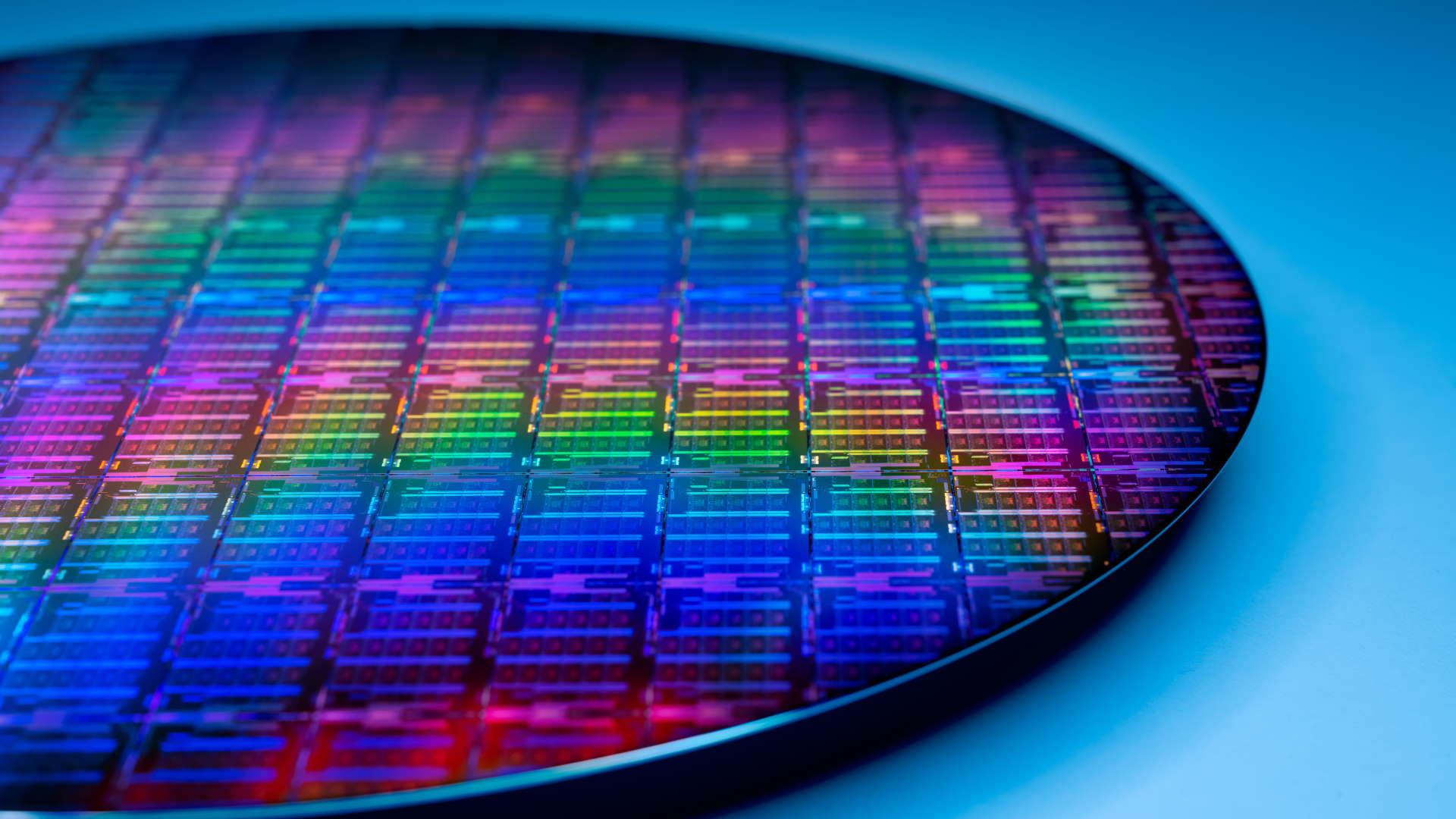
Traditional GPUs fight this with bigger memory stacks and faster interconnects. Cerebras took a different road: instead of cutting a silicon wafer into dozens of separate chips, it uses the entire wafer as a single processor. One wafer, one giant chip, with all of its memory sitting right there on the silicon.
The wafer itself: 44 GB that never leaves the chip
The current Cerebras wafer, the WSE-3T, holds 44 GB of on-chip SRAM. SRAM is the fast, expensive kind of memory that sits closest to the compute, and 44 GB of it on one piece of silicon is an absurd amount. Cerebras's pitch is that this difference changes the whole serving equation. If the model's weights fit on the chip, they never have to move. And if weights never move, the only thing travelling between stages of the model is the intermediate result — the activations — which are tiny by comparison. That is the whole philosophy in one sentence: keep the weights still, move as little else as possible.
It is a beautiful idea. It also runs straight into a hard limit: 44 GB per wafer, and a three-trillion-parameter model needs terabytes. So how do you bridge that gap? You use more wafers, and you split the model the right way.
The math, step by step
This is the part I loved, because Cerebras shows its working, and the working is simple enough to check on a napkin.
Start with the model. Kimi K3 has roughly three trillion parameters, spread across 93 layers: 69 linear-attention and 24 dense, full-attention.
Next, shrink the weights. At 4-bit quantization, each parameter takes half a byte, so three trillion parameters need about 1.5 terabytes. Divide that by 93 layers and each layer needs roughly 16 GB — the hinge everything swings on, because 16 GB fits comfortably inside a 44 GB wafer.
Now the layer types decide the packing. A dense layer stores keys and values for every token in every active request — the KV cache — and that cache grows with context length, so a dense layer gets a whole wafer to itself. A linear-attention layer keeps a small, fixed-size state per request no matter how long the context gets, so two linear layers fit on one wafer: two times 16 GB is 32 GB.
Do the arithmetic. Twenty-four dense layers, one wafer each: 24 wafers. Sixty-nine linear layers, two per wafer: 35 wafers. Add them up and you get 59 wafers for one model.
I have been building software long enough to distrust any number that comes out too clean, but this one checks out. The model was not designed for Cerebras hardware — the layer count, the quantization, the wafer capacity just happen to divide this way.
The pipeline: only activations cross the gap
Fifty-nine wafers do not help if they cannot talk to each other fast enough. Cerebras connects them in a pipeline: the compiler maps the model's layers across regions of wafers, and the runtime maps the path tokens take through them. Each wafer runs its assigned layers and passes the intermediate results to the next stage. Because each layer fits entirely on its wafer, the weights never cross between wafers at all — only activations move, over RDMA at roughly two microseconds per hop.
The result, according to Cerebras, is output speeds of 1,000 to 2,000-plus tokens per second for multi-trillion-parameter models, with an 8-bit KV cache for the dense layers. If that speed holds up in practice, it changes what a giant model feels like to use. At a thousand tokens a second, a long coding response that takes a minute today arrives in seconds.
The honest caveats: a recipe, not a benchmark
Now the part where I pump the brakes, because the full picture is more careful than the headline.
First, Cerebras itself presents Kimi K3 as an illustrative example, not a measured deployment result. The post walks through how the model would be served on this hardware. It does not claim that this exact 59-wafer layout was run, measured, and benchmarked end to end. Independent coverage has made the same point: this is a deployment recipe, and the performance breakthrough still needs a measured result.
Second, the speed claim comes with assumptions. Coverage of the post notes an assumed average request size of around 256,000 tokens, and the honest efficiency metric — tokens per second per megawatt at matched speed — is not given for this layout. One widely shared back-of-the-envelope estimate from the Hacker News discussion put the whole rig at roughly 1.18 megawatts. That is a commenter's arithmetic, not Cerebras's number, and I am flagging it as such because it shows the other side of the ledger: fifty-nine wafers will drink serious power, and nobody has published the power bill for this layout yet.
Third, there is a gap between the recipe and what you can actually use today. Community reports note that the models publicly available on Cerebras's cloud are far smaller — in the 120-billion-parameter class and below. The 59-wafer Kimi layout is a statement about where the hardware can go, not a button you can press this week.
None of this makes the post uninteresting — a credible recipe from the hardware maker, with checkable arithmetic, is genuinely useful. It just means you should read "1,000 to 2,000 tokens per second" as a design target for this layout, not a benchmark you can reproduce on Monday morning.
Why this matters beyond the hardware crowd
You might be wondering why a WordPress and web developer is writing about wafer-scale chips. Fair question. Here is my answer: inference economics decide what features the rest of us can ship.
Every time model serving gets cheaper and faster, something that was a premium feature becomes a default one. When a coding assistant answers in seconds instead of a minute, developers actually use it. When a support bot can read a whole documentation set in context without the bill exploding, small sites can offer it, not just enterprises. The hardware story is never just a hardware story. It is the price list for everything we build on top.
The open-weight angle matters here too. Kimi K3 is an open model from Moonshot AI, and Cerebras chose an open model for its worked example. If giant open models become servable at these speeds, the frontier stops being something you can only rent from a handful of labs.
There is also a lesson in the layer-type detail that applies far beyond Cerebras. Kimi K3's mix of linear and dense layers is not an accident: linear attention exists precisely because the KV cache of dense attention gets ruinously expensive at long contexts.
What I am watching next
Three things will tell me whether this recipe turns into reality.
The first is a measured run: the same 59-wafer layout, or something close to it, serving a real trillion-parameter model with published throughput, latency, batch size, and power draw. Until then, treat the speed as a claim with good arithmetic behind it.
The second is availability. When a model in the trillion-parameter class actually appears in Cerebras's public offering, and developers can measure it themselves, the conversation changes from theory to practice.
The third is the competition's answer. The winner will not be the vendor with the cleverest diagram, but the one whose numbers survive contact with real workloads.
Conclusion
Fifty-nine wafers to run one model sounds like excess until you see the math. Three trillion parameters at 4-bit precision, divided into 93 layers of about 16 GB each, packed onto 44 GB wafers at one dense layer or two linear layers apiece — that is how you serve a giant without ever moving its weights. The pipeline only carries activations, the hops take microseconds, and the claimed speed is fast enough to make a giant model feel instant.
Read it with the caveats attached: an illustrative example, not a measured benchmark, with power and request-size assumptions still unpublished. But do not let the caveats bury the insight. Frontier inference is becoming an exercise in keeping weights still and moving as little else as possible. The model is no longer the hard part. The plumbing is.
Frequently asked questions
What is Cerebras's 59-wafer claim?
Cerebras published a technical post on October 22, 2026, showing how its wafer-scale hardware would serve the roughly 3-trillion-parameter Kimi K3 model: 24 wafers for the dense layers and 35 for the linear-attention layers, 59 in total.
How does the wafer math actually work?
At 4-bit quantization, 3 trillion parameters need about 1.5 TB, or roughly 16 GB per layer across 93 layers. Each WSE-3T wafer holds 44 GB of on-chip SRAM. Dense layers take one wafer each for KV cache room; linear-attention layers need no KV cache, so two fit per wafer. That gives 24 plus 35, or 59 wafers.
What is Kimi K3?
Kimi K3 is a large open model from Moonshot AI with around 3 trillion parameters across 93 layers. Cerebras used it as the worked example in its deployment post, and reports of the post cite scores of 88.3% on Terminal-Bench 2.1 and 91.2% on BrowseComp.
Is the 1,000 to 2,000 tokens per second speed a measured benchmark?
No, not for this layout. Cerebras advertises that speed range for multi-trillion-parameter models, but the Kimi K3 post is an illustrative deployment recipe, not a published end-to-end benchmark. The efficiency metric, tokens per second per megawatt, was not given for this layout.
Why does it matter that weights never move?
Moving weights from memory to processors is the main bottleneck in serving large models — the memory wall. Because each layer fits entirely on its wafer, only small activations travel between wafers, over RDMA at about 2 microseconds per hop. That is why the design can claim such high speeds despite the model's size.
Can developers use a 59-wafer Kimi K3 deployment today?
Not through a public offering yet. The models publicly available on Cerebras's cloud are far smaller, and the 59-wafer layout is a published recipe rather than a product you can call today. Its value right now is showing what the hardware can do and what serving economics could look like as giant open models become runnable.


