
I have a rule for keynotes: ignore the adjectives, write down the availability dates. "Revolutionary" means nothing; "generally available today" means something. So when Satya Nadella opened Microsoft Ignite 2026 in San Francisco on Tuesday, November 17, and called Copilot "the new OS for work," I waited for the part that matters — what ships now, what costs less, and what a WordPress developer can use on Wednesday morning.
The answer is more interesting than the slogan. Copilot got rebuilt around four modes — Chat, Cowork, Code, and Autopilot — and Microsoft launched six of its own AI models, including a coding model it claims does 96% of Claude Opus 5.5's job at 5% of the cost. Some of it is available today. Some of it is gated behind early access. And some of it is a vendor benchmark that deserves skepticism. Here's what I'd trust, and what I'd wait on.
Copilot Is Now Organised Around Four Modes
The headline change is structural, not cosmetic. Copilot is no longer a chatbot bolted onto Office apps. Nadella's keynote reorganised it into one experience with four modes: Chat for asking, Cowork for delegating multi-step assignments, Code for building, and Autopilot for work that keeps moving without you.
Two pieces are already generally available. Home and Office in Copilot are GA now, and Copilot Workspaces — shared spaces where people and agents work on the same project with shared context, carried on inside Teams — turn the old Copilot Notebooks into something closer to a team room than a document.
Copilot Code is the mode with the longest runway. It lets anyone build dashboards, trackers, and apps in natural language, with enterprise security and governance built in. Microsoft expects it to reach general availability in December — it is not GA yet, so treat it as a preview promise, not a tool you can hand a client this week.
Autopilot: The Agent That Works While You Sleep
Autopilot is the mode that got the most stage time, and the one that needs the most careful reading. It is a persistent personal agent with its own identity, memory, and tools inside your organisation's Microsoft environment. It keeps moving recurring work forward 24 hours a day, 7 days a week, without being prompted at every step. Colleagues can even @mention someone's Autopilot in a Teams channel, the way they'd mention the person. Microsoft Scout, introduced in June 2026, was its first Autopilot agent; what Ignite did was put a name, an identity system, and a rollout behind the idea. Autopilot is reaching Frontier customers now — Microsoft's early-access program — not the general public.
That gating matters. Every Autopilot agent gets a unique ID, and Agent 365 Business Analytics tracks what agents do — the governance layer enterprises kept asking for. But if you're a freelancer or a three-person agency, you are not a Frontier customer, and Autopilot is something to watch, not something to plan a workflow around yet.
The idea itself is the real shift. A chatbot answers when asked. An agent with memory and identity acts between asks — remembering your client's brand rules, noticing a draft is waiting, moving it forward without a prompt. That is also where the risk lives: an agent acting on stale memory can do a lot of quiet damage before anyone notices. Microsoft's answer is identity, audit trails, and analytics. Whether that is enough is a question every team will answer for itself, one incident at a time.
Six New MAI Models — and a Price War Aimed at OpenAI and Anthropic
The model announcements are where Ignite gets concrete for developers, because two of them are available today. Microsoft AI CEO Mustafa Suleyman introduced six new models covering coding, cybersecurity, image generation, and voice — and the pitch is the same in every case: near-frontier performance at a fraction of the cost.
MAI Code 2 is the flagship: an agentic coding model family built for taking code to production, deep debugging, multifile implementation, repo-wide reasoning, and UI work. Microsoft claims it delivers 98% of GPT-6.1 Sol's coding performance at 40% of the price, and 96% of Anthropic's Claude Opus 5.5 performance at 5% of the cost. MAI Code 2 Flash is the smaller, faster sibling for high-volume work — code explanations, targeted edits, routine fixes — claimed to match GPT-6 Luna at 65% of the price and Claude Haiku 5.5 at 20% of the cost. Both are generally available today on GitHub Copilot, in the model picker and as part of Copilot Fusion, and in Azure AI Foundry.
Read those numbers the way you'd read any vendor benchmark: as a claim, not a fact. But the direction is unmistakable, and it lands on the same day OpenAI launched GPT-6.2 Astra and Sol with a 20% price cut of its own — a launch I covered here this morning. Two vendors cutting prices on the same day is a price war, and developers benefit.
MAI Cyber 2 Flash is the security model, and its claim is the boldest of the lot: Microsoft says it outperforms GPT-6 Astra on a cybersecurity benchmark at less than 2% of the cost per task. It's integrated with Perception, Microsoft's agentic security system. MAI Image 2.7, which Microsoft places first for image editing, is in preview, along with new transcription and real-time speech models.
Then there's Microsoft Decision 1.1, now generally available — a decision-making model for classification, routing, prioritisation, result verification, and workflow control, now with multimodal support. Microsoft claims it is 50 times faster than GPT-6.1 Sol at 79 times lower cost. Again, vendor numbers — but the category matters: a model whose job is to decide, not to write or chat, is the unglamorous work agents spend most of their time doing. Finally, MAI Licensed Weights lets trusted customers access Microsoft AI model weights through Frontier Co. — a real shift for teams that want to tune rather than rent.
What Changes Inside GitHub Copilot
For most WordPress developers, Ignite's most usable news isn't Autopilot or the keynote — it's the model picker in GitHub Copilot. Code 2 and Code 2 Flash are there today, and they arrive alongside Copilot Fusion, generally available since October 28 at GitHub Universe. Fusion takes model selection off your plate: it routes work to one model, checks a draft before escalating to a stronger one, or has several models critique a response before it's revised.
GitHub reported that Fusion Max scored within two points of Claude Code running Opus 5.5 Max on the Artificial Analysis Coding Agent Index, at roughly half the average API cost per task and about 40% less time. That's GitHub's number, on an independent index, which makes it more interesting than a keynote slide — though "within two points" is doing a lot of work.
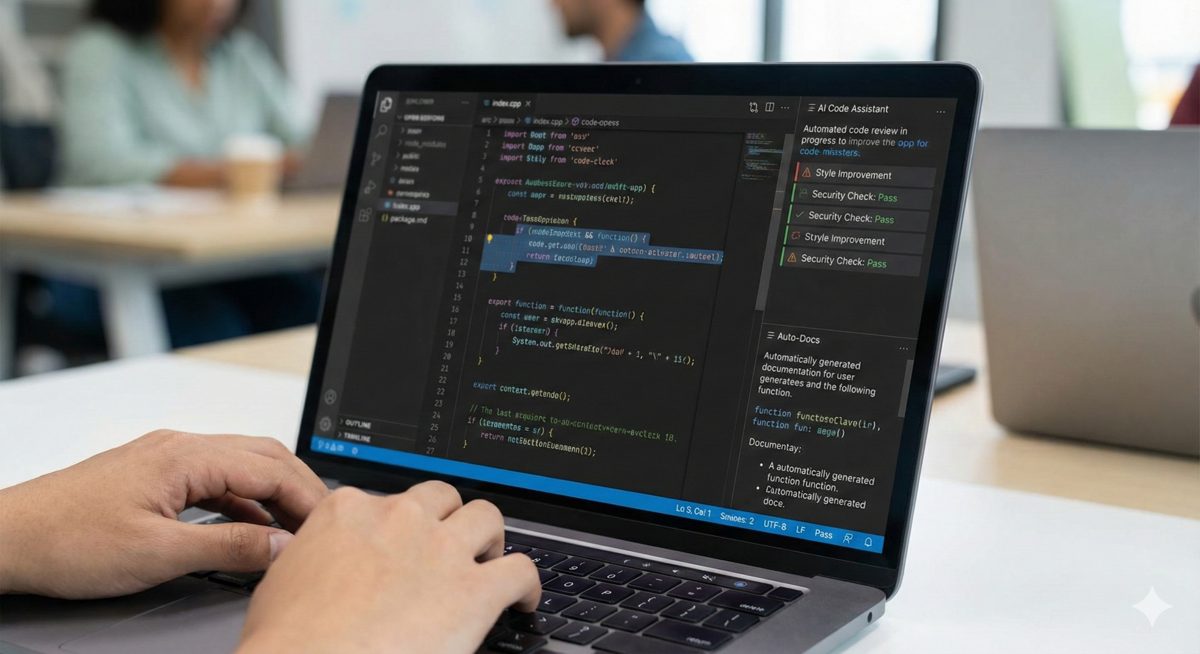
Here's how I'd actually use this. If you build custom plugins, themes, or WooCommerce customisations in VS Code with Copilot, try Code 2 on a real job this week — a multifile refactor, a migration script, a bug that spans three files. Compare it against whatever model you use now, on your own code, not on a benchmark.
And GPT-6.2 is coming to Azure AI Foundry too, alongside Meta's latest models. Foundry is becoming a model supermarket — OpenAI, Anthropic via Copilot, Meta, and now Microsoft's own MAI family, all in one place. Model choice becomes a line item you revisit quarterly, not a marriage.
The Platform Underneath: Maia 300, HorizonDB, and Perception
Keynotes bury infrastructure news, but Ignite had three items worth noting for anyone who runs sites for a living. First, Maia 300, Microsoft's AI accelerator, promises 40% more tokens per watt compared with leading GPU-based systems. Cheaper tokens per watt is what makes the MAI price claims physically possible — the models are cheaper because the hardware running them is more efficient. That is the part of the price war that isn't marketing.
Second, HorizonDB is now generally available — Microsoft's database play for the agent era, built for workloads where agents read and write constantly. Third, Microsoft Perception is now generally available: an agentic security system where red-team agents simulate attacks, blue-team agents detect them, and green-team agents fix and remediate — at machine speed, composed through playbooks, powered in part by the MAI-Cyber models.
Perception is the one I'd watch most closely. It lands in the same week as two security stories I covered here: an AI agent turning security patches into working exploits, and the FBI warning about WordPress sites serving malware through Google search. Security is becoming an agent-versus-agent problem. A system that red-teams your own site continuously, rather than once a year in an audit, is the shape of that future — enterprise-priced today, but coming to every tier of hosting and tooling within a couple of years.
What This Means for WordPress and Elementor Work
So what do I actually do differently this week? Four things, in order of how much they matter.
First, try MAI Code 2 in GitHub Copilot. It's free to test inside a Copilot subscription you may already pay for, it's available today, and the cost claims — even discounted by half for vendor optimism — would still make it the cheapest capable coding model in my rotation. Test it on plugin scaffolding, theme refactors, and the kind of multifile job where a model usually loses the thread. If it holds up, it becomes my default for routine WordPress work, with a frontier model as the escalation — the same split I use with OpenAI's Sol and Astra.
Second, watch Copilot Code's December general availability. A tool that lets a client build their own dashboards and trackers in natural language changes what "I need a custom dashboard" means. Some of that work stops being a developer job and becomes a client self-service job — which is fine, as long as you're the one showing them how, and the one they call when the self-service version breaks.
Third, take the Autopilot idea seriously even though you can't use it yet. WordPress and Elementor are moving the same direction: Elementor 4.4 shipped Agent Ready features, including llms.txt support, so AI agents can read and work with your site. The near future is agents that don't just help you build pages — they read your site, understand it, and act on it. The question isn't whether it arrives, it's whether you set the guardrails.
Fourth, don't reorganise your business around Frontier. Autopilot, Copilot Workspaces, and MAI Licensed Weights are all gated or enterprise-shaped right now. The usable part today is the coding models in GitHub Copilot and Decision 1.1 in Foundry. Everything else is a roadmap with a name.
The Catches Worth Naming
Three caveats, because a launch post that skips them isn't honest. First, the price claims are Microsoft's, and the most aggressive ones — 5% of the cost, less than 2% of the cost — are the ones most likely to shrink under independent testing. The only test that matters is your code, your repo, your bill.
Second, the Copilot "OS for work" vision depends on you living inside Microsoft's world. Autopilot's identity, memory, and tools work inside your Microsoft tenant. If your agency runs on Google Workspace, or your clients do, the vision thins out fast.
Third, the timing. Ignite runs November 17 to 20, and many announcements are previews or Frontier-limited. The details — pricing pages, docs, real availability — will keep arriving through the week. Check the availability before planning around any of it.
Conclusion
Ignite 2026 is best read as Microsoft declaring independence. For years it was OpenAI's biggest partner and best customer; now it's shipping its own models, its own coding assistant stack, its own accelerator, and an agent platform with its own identity system — while still bringing GPT-6.2 to Foundry, because independence and partnership are not mutually exclusive here.
For WordPress developers, the usable news is narrow and good: a cheaper coding model in GitHub Copilot today, a decision model that could quietly cut the cost of agent workflows, and a clear signal that the agent era is arriving on a schedule measured in months, not years. The rest is a keynote: watch it, note the dates, and wait for the general availability that actually matters.
Frequently Asked Questions
What did Microsoft announce at Ignite 2026?
On November 17, 2026, at Ignite in San Francisco, Microsoft rebuilt Copilot around four modes — Chat, Cowork, Code, and Autopilot — calling it "the new OS for work," and launched six in-house MAI models covering coding, cybersecurity, image generation, and voice, plus the Microsoft Decision 1.1 model, the Maia 300 AI accelerator, HorizonDB, and the Perception agentic security system.
What is Copilot Autopilot?
Autopilot is a persistent personal agent inside Microsoft 365 Copilot with its own identity, memory, and tools. It keeps moving recurring work forward 24/7 without being prompted at every step, and colleagues can @mention someone's Autopilot in a Teams channel. It is rolling out to Frontier (early-access) customers first, not to everyone at once.
What is MAI Code 2, and where can I use it?
MAI Code 2 is Microsoft's flagship family of agentic coding models, for production code, deep debugging, multifile work, and repo-wide reasoning. It is generally available now in GitHub Copilot — in the model picker and in Copilot Fusion — and in Azure AI Foundry. Microsoft claims 98% of GPT-6.1 Sol's performance at 40% of the price, and 96% of Claude Opus 5.5 at 5% of the cost; those are vendor claims, not independent benchmarks.
Is MAI Code 2 cheaper than Claude and GPT models?
On Microsoft's numbers, yes — dramatically. Code 2 is claimed at 40% of GPT-6.1 Sol's price and 5% of Claude Opus 5.5's cost for comparable coding performance, while Code 2 Flash is claimed at 65% of GPT-6 Luna's price and 20% of Claude Haiku 5.5's cost. Treat these as marketing claims until independent tests confirm them, but even a fraction of the claimed savings would make Code 2 the cheapest capable coding model available.
When will Copilot Code be generally available?
Microsoft expects Copilot Code — the mode that lets anyone build dashboards, trackers, and apps in natural language — to reach general availability in December 2026. It is not GA yet, so it's a preview promise for now, not a tool to hand a client this week.
What does Ignite 2026 mean for WordPress and Elementor users?
The immediate impact is a cheaper coding model in GitHub Copilot for plugin and theme work, and cheaper decision-making models for agent workflows. The longer impact is the agent direction: Elementor 4.4 already added Agent Ready features with llms.txt support, and Copilot Autopilot points to a near future where agents with memory tend your site — updating content, triaging forms, and acting on your site — which means setting guardrails for what agents may and may not touch.
Sources: Microsoft official Ignite 2026 blog (Nov 17, 2026), The Neuron, dev.to Ignite keynote coverage, KuCoin News (Microsoft model announcements). Benchmark and price figures are Microsoft-reported unless noted as independent.