

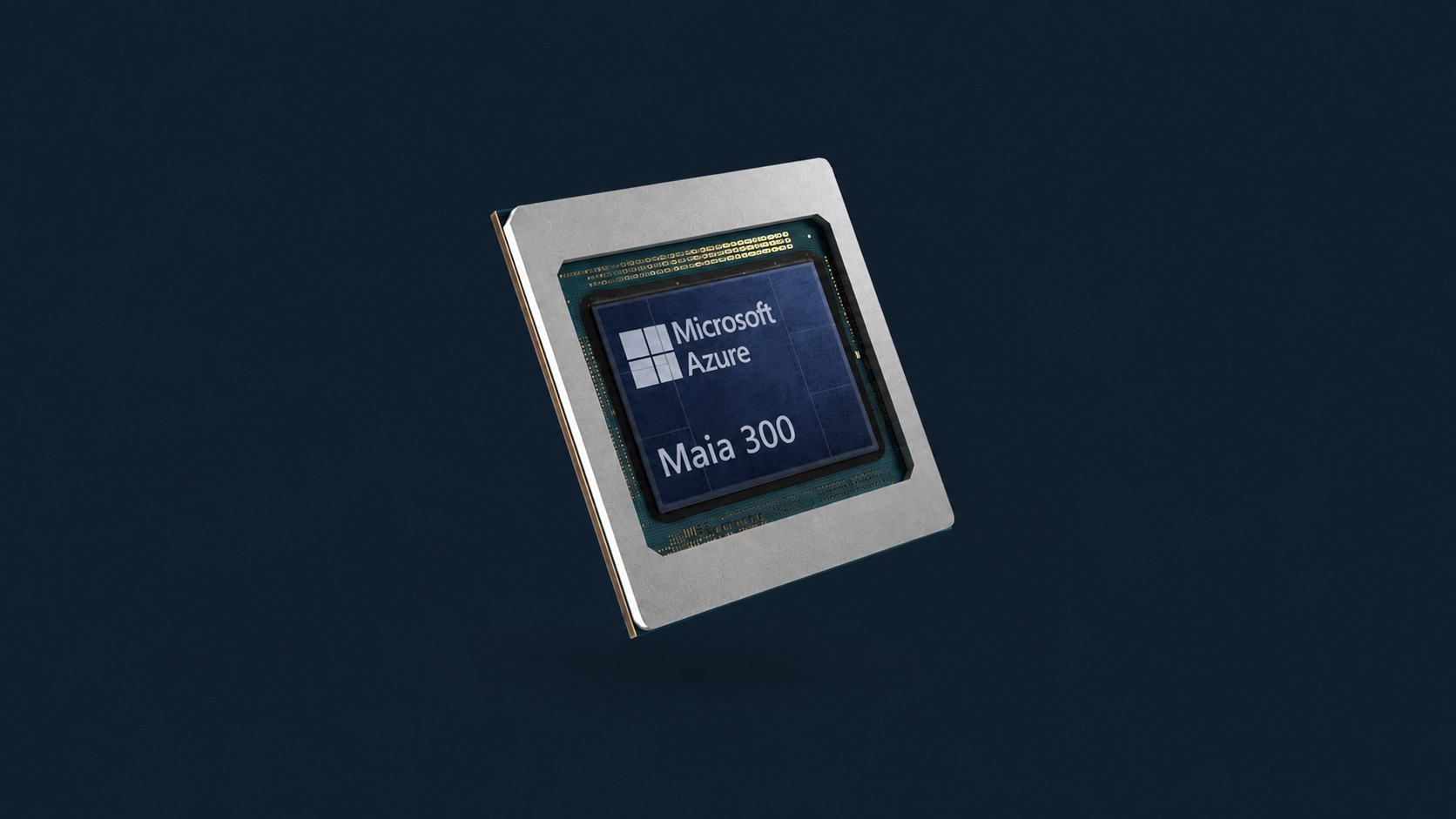
Monday morning brought the kind of news that makes me put down my coffee and actually read the whole press cycle. Microsoft unveiled the Maia 300 — its third-generation custom AI chip — and the ambition behind it is honestly staggering. The company says it plans to deploy more than a million of these chips next year to power its own AI services. Let that sink in for a second. A million chips. Not sold to customers. Built for Microsoft itself.
I've been watching the custom-silicon arms race for years, partly as a developer who rents GPU time and feels every price change. This announcement is really about who pays for AI compute, and how much.
Here's what Microsoft actually announced, what the specs mean in plain language, and the one catch worth understanding before you get too excited.
What Microsoft Actually Announced
On October 12, 2026, Microsoft pulled the covers off the Maia 300, the successor to the Maia 200 (which launched earlier this year) and the original Maia 100 (from 2023). This is the company's third swing at designing its own AI accelerator, and this time the language around it is completely different.
Microsoft Azure chief Scott Guthrie said in a blog post that Maia will become, in his words, the primary AI inference system for Microsoft's products and services. CEO Satya Nadella went further, calling it "our biggest bet yet on our own silicon" in a post on X.
Reuters reported the detail that matters most for scale: Microsoft plans to deploy potentially more than a million of these chips next year. Andrew Wall, the general manager for Azure Maia, said the company expects its Maia deployments to support AI workload demand "measured in gigawatts." That's not a data center metric — that's a power-grid metric. And Microsoft is reportedly in talks with TSMC to secure more than 300,000 Maia 300 chips for delivery in 2027. This isn't a research project. It's a procurement pipeline.
The Specs, Translated for Humans
Let me walk through the numbers, because on paper this thing is a monster — and I think the memory configuration is the real story.
The headline figures: up to 13.8 PFLOPS of FP4 compute and 6.9 PFLOPS at FP8 — the low-precision formats modern AI inference lives on, so don't compare them directly with FP32 numbers on a gaming GPU.
Now the memory, which is the real story. The Maia 300 carries 288GB of HBM4 across eight stacks, delivering up to 18 terabytes per second of bandwidth at 9 gigabits per second per pin. The Maia 200 had 216GB of HBM3E at 7 TB/s — so bandwidth roughly tripled in one generation while moving to HBM4. That matters enormously for inference, because when you're serving a giant model, the bottleneck is almost always how fast you can feed weights from memory into the compute cores, not the raw math.
The chip draws 950 watts (up from 750W on the Maia 200), ships in racks of 96 accelerators at about 167 kilowatts, and scales out over 3.2 TB/s of bidirectional bandwidth to clusters of up to 12,000 accelerators.
Why Chiplets — and Why That's a Real Engineering Bet
Here's the part I find genuinely interesting as someone who builds on this infrastructure. NVIDIA's approach has been one massive computing chip surrounded by high-bandwidth memory. Microsoft went the other way: the Maia 300's central processor is built from chiplets — specialized smaller chips bonded together.
The compute chiplets use TSMC's 2-nanometer process for the heavy lifting, while the supporting chiplets that move data around the system use cheaper 3-nanometer. Smart engineering economics: you don't need the most advanced (read: most expensive) process node for plumbing. You spend the premium silicon budget exactly where the math happens.
Microsoft also leans on the MXFP4 low-precision format to cut the memory bandwidth needed per operation. Rani Borkar, president of Azure hardware systems and infrastructure, framed it as delivering more intelligence for every watt, every dollar, and every byte of memory by optimizing the entire system — not just the chip. And Microsoft's numbers: about 40% more tokens per megawatt than leading GPU-based systems, up to seven times the rack-scale throughput of the Maia 200, and more than 2.5 times the performance per watt.
The Money Story: This Is About Margins, Not Benchmarks
Strip away the specs and this announcement is really about economics. Every time you ask Copilot to summarize a document or an agent to run a multi-step task on your behalf, Microsoft pays for that compute. Training a model is a one-time bill. Serving it to hundreds of millions of users is a bill that arrives every single day, forever.
Microsoft told investors that running OpenAI's models and its own models on the current Maia 200 costs 30% to 40% less than running them on comparable NVIDIA hardware. The Maia 300 is designed to widen that gap — and when your annual capital expenditure is climbing toward $175 billion, shaving 30-40% off inference costs is the difference between a business model that works and one that slowly drowns in its own success.
This is also why power is the headline metric instead of raw speed. You can have the fastest chip in the world, but if you can't get the electricity to run a million of them, it doesn't matter. Designing the chip, memory, networking, rack, and software together — instead of treating the accelerator as an interchangeable part — is how you win the power game. As analyst Pat Moorhead put it, at this scale custom silicon stops being a performance story and becomes a margin driver.
The Catch (Because There's Always One)
Okay, time to pump the brakes, because I've seen too many chip announcements get treated as obituaries for the incumbent.
First: Maia is expected to represent only about 10% of Microsoft's AI chip spending through 2027. NVIDIA and AMD hardware remains critical — especially for training workloads, which the Maia 300 isn't designed for. This chip is an inference specialist. Training still belongs to NVIDIA.
Second: that "40% more tokens per megawatt" claim is against "leading GPU-based systems" that Microsoft didn't name. Until independent testing exists, treat it as a projection from the company selling the chip, not a verified benchmark. The sevenfold figure is measured against Microsoft's own previous generation at rack scale — a fair comparison, but not the same as being seven times faster than an NVIDIA GPU.
Third: Microsoft is playing catch-up. Google and Amazon have deployed custom silicon at meaningful scale for years, and Microsoft is reportedly trying to persuade large AI customers like Anthropic to move workloads onto Maia instead of the Amazon and Google chips they currently use. That's a sales job, not a done deal. As Nadella has privately framed it, the dependence makes Microsoft "a very thin layer on top of NVIDIA" — the Maia 300 is the attempt to thicken that layer. A worthy goal, but one generation of chips doesn't undo a decade of ecosystem lock-in.
What This Means for Developers Like Us
So what do I actually take away from this, sitting at my desk building websites and tools?
The most important thing: the AI industry's cost center is shifting decisively from training to inference. For the last three years, all the headlines were about who trained the biggest model. Now the fight is about who can serve a response the cheapest. That's the game that determines what developers like me pay for API calls and what users pay for subscriptions.
If Maia 300 delivers even half of what Microsoft claims, the long-term effect is cheaper, more abundant inference — AI features baked into everything instead of premium add-ons. The workloads it's tuned for — coding assistants, agents working through multi-step jobs, models chewing through long documents — are exactly the workloads eating my budget today. GitHub Copilot and Microsoft 365 Copilot already run on Maia 200 in data centers across the US, Europe, and Australia; the 300 generation extends that runway.
The Arms Race Is the Real Story
Zoom out and the Maia 300 is one move in the biggest capital deployment in tech history. In the same week: OpenAI debuted its own in-house chip, Amazon is reportedly pursuing a $7 billion acquisition of AI startup Decart — whose software helps developers run AI chips more efficiently — and Google keeps printing money on its TPU franchise. Every hyperscaler has now decided that renting NVIDIA's margins forever is not a strategy.
My honest read: the Maia 300 won't dethrone NVIDIA. It doesn't need to. It needs to make Copilot profitable at planetary scale, and on that score, Microsoft is making exactly the right bet. The rest of us get cheaper inference out of it. That's a win I'll take.
Conclusion
The Maia 300 is Microsoft's most serious attempt yet to own its AI destiny: a 2nm chiplet design with 288GB of HBM4, built for the inference workloads that actually cost money, deploying at gigawatt scale starting in 2027. The economics are compelling — 30-40% cheaper inference on the current generation, with the new chip pushing further. The caveats are real too: it's still a small fraction of Microsoft's chip spend, the headline comparisons are Microsoft's own, and training still belongs to NVIDIA.
But here's what I'll remember about this week: the AI race officially stopped being about who has the smartest model and started being about who can afford to run it. Tokens per megawatt is the new parameter count. And on that metric, Microsoft just placed the biggest bet in its history.
Frequently Asked Questions
When will the Microsoft Maia 300 be available?
Microsoft plans to begin large-scale deployments in 2027, with talks underway with TSMC to secure more than 300,000 chips for that year and ambitions for over a million units. It will power Microsoft's own Azure AI services — it's not a product you can buy off a shelf.
Is the Maia 300 faster than NVIDIA's GPUs?
That's the wrong comparison. The Maia 300 is an inference specialist, while NVIDIA's flagship GPUs are built for both training and inference. Microsoft claims 40% more tokens per megawatt than unnamed leading GPU systems and 7x the rack-scale throughput of its own Maia 200 — but these are Microsoft's figures, not independent benchmarks. Treat them as direction, not gospel.
What is a chiplet design, and why does it matter?
Instead of one giant chip, the processor is assembled from smaller specialized chips (chiplets) bonded together. Microsoft puts the compute chiplets on TSMC's advanced 2nm process and the data-movement chiplets on cheaper 3nm — spending premium silicon only where the math happens. It's cheaper to manufacture and easier to scale than one massive die.
Does this mean NVIDIA is in trouble?
Not really. Maia is expected to stay around 10% of Microsoft's AI chip spending through 2027, and NVIDIA hardware remains essential for training. NVIDIA's real risk isn't one chip — it's that every major customer is now building an exit ramp. That's a slow problem, not a sudden one.


