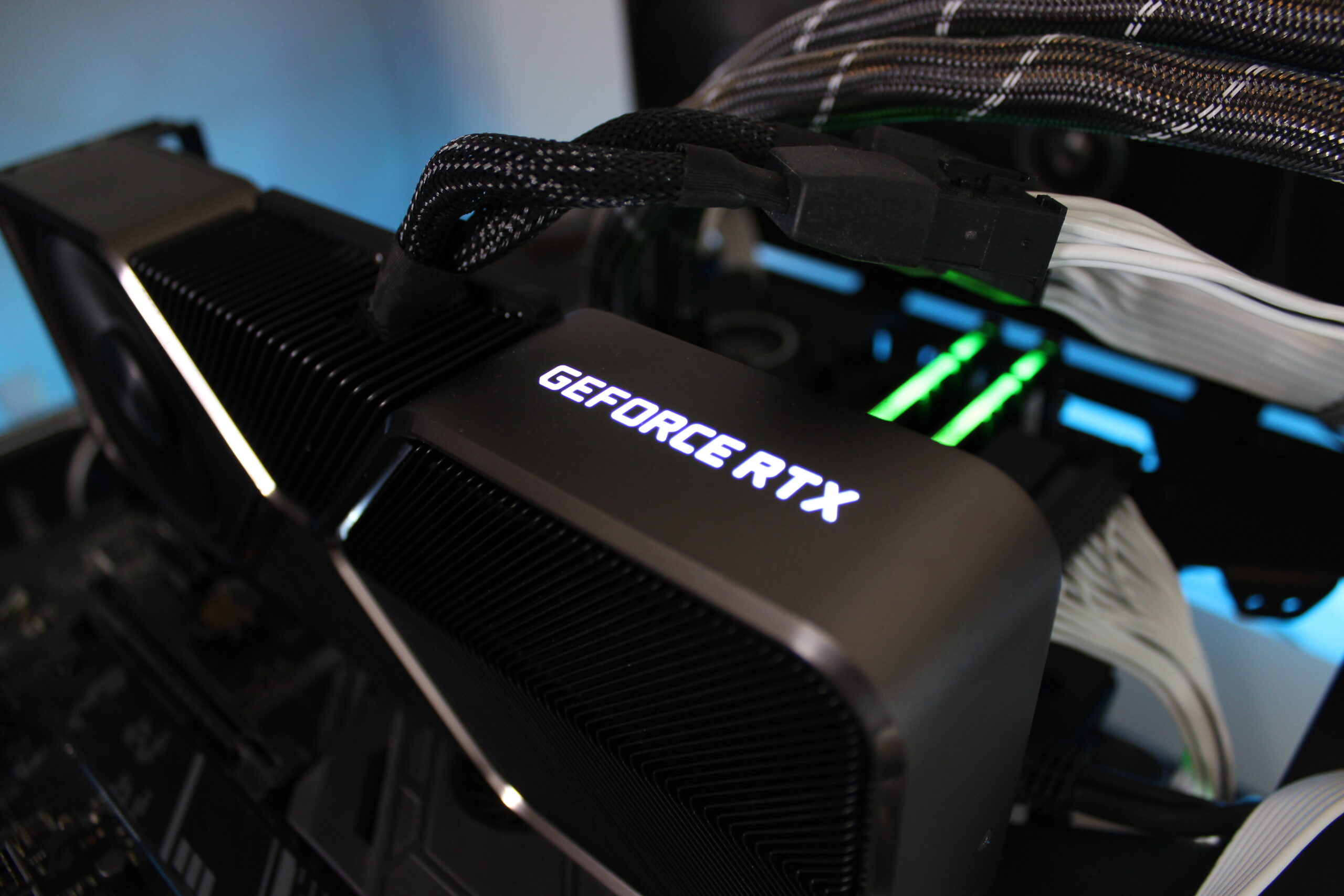
I have been building gaming PCs for the better part of a decade, and I have never seen a graphics card launch quite like the RTX 5090. On paper, it is everything a flagship should be: a brand-new Blackwell architecture, 32GB of video memory, and frame rates at 4K that make last generation look slow. In the real world, almost two years after launch, it is also the most frustrating graphics card I have ever tried to recommend to anyone — because the card Nvidia sells for $1,999 routinely costs $5,000 or more on the street. This is my honest take on the fastest gaming GPU ever made, who it is actually for, and why most of us should stay far away from it.
What you actually get for your money
Let me start with the hardware, because it genuinely is impressive. The RTX 5090 is built on Nvidia's Blackwell architecture — the GB202 chip, made on TSMC's 4NP process — and it packs 21,760 CUDA cores, 680 fifth-generation Tensor cores, and 170 fourth-generation RT cores. It carries 32GB of GDDR7 memory on a massive 512-bit bus, delivering 1,792 GB/s of memory bandwidth. That is roughly 78% more bandwidth than the RTX 4090, and for AI workloads and 4K gaming alike, bandwidth is the number that matters most. The card is rated at 575 watts, it needs a 16-pin power connector, and it runs on PCIe Gen 5. Nvidia's official launch price was $1,999 when the card arrived in January 2025.
Those numbers translate into real capability. The 32GB of VRAM is the headline for anyone doing creative work or local AI: it can hold 13-billion-parameter models at FP16 with room to spare, and 25-billion-plus models at INT8. For video editors, 3D artists, and developers running local language models, that memory ceiling is the difference between a workflow that works and one that constantly swaps to system RAM.
Real performance: about 30% faster, and that is honest
Forget the marketing slides for a minute. In native 4K rasterized gaming — no upscaling, no frame generation, just the raw GPU doing the work — the RTX 5090 is roughly 25 to 35% faster than the RTX 4090, depending on the game. Tom's Hardware reported a 24% lead in its June 2026 GPU hierarchy at 4K Ultra, with the 5090 averaging 110.8 frames per second against the 4090's 89.1. A 3DCenter meta-review across 17 reviews landed on a 28.6% average lead. In Cyberpunk 2077 at 4K with ray tracing on Ultra and no upscaling, Gamers Nexus measured 53 frames per second on the 5090 versus 39 on the 4090 — a 36% gap. That is a real generational jump, the kind we used to get every two years and have lately been told to stop expecting.
At 1440p, the gap shrinks to around 10 to 25%, because the CPU starts becoming the bottleneck — a reminder that a flagship GPU only makes sense if the rest of your system can keep up. At 1080p, buying this card is almost comical; you are paying for performance your monitor and CPU will never let you see. The 5090 is a 4K card, full stop, and ideally a 4K high-refresh-rate card paired with an OLED display that can actually show what it is doing.
Ray tracing is where the lead grows. In path-traced games, the fourth-generation RT cores and the new neural rendering features pull further ahead of the 4090. Cyberpunk 2077 with full path tracing at native 4K still brings even this card to its knees — around 25 to 30 frames per second without help — but that is the hardest rendering workload in consumer gaming, and no other card on the market does meaningfully better. The 5090 is not magic. It is just the fastest thing you can buy, by a clear margin.
DLSS 4.5 is the real reason to care
Here is the thing I keep coming back to: the raw raster performance is only half the story. The other half is DLSS 4, and now DLSS 4.5, which Nvidia announced at CES 2026. Multi Frame Generation can insert up to three AI-generated frames for every traditionally rendered frame — four times the output — and the new DLSS 4.5 pushes that to six times with Dynamic Multi Frame Generation, automatically adjusting the multiplier to hold smooth 240-plus frame rates at 4K. In Cyberpunk 2077 with path tracing at 4K, DLSS 4.5 in Performance mode with dynamic multi-frame generation takes that unplayable 25 to 30 frames per second and turns it into 130-plus, at image quality that reviewers describe as near-native.
I am still skeptical of frame generation in principle, but I have to be fair: Nvidia's transformer-based Super Resolution model is genuinely good now, and the Reflex low-latency tech that pairs with it keeps the experience feeling responsive as long as your base frame rate stays above roughly 60. Over 250 games and apps now support DLSS 4 with Multi Frame Generation, including ARC Raiders, Battlefield 6, Clair Obscur: Expedition 33, and Where Winds Meet. If you buy a 50-series card, this is the feature you will actually use every day. It is not a gimmick anymore.
The price problem, and it is a big one
Now the part that ruins the recommendation. The RTX 5090 launched at $1,999. In November 2026, you will not find it anywhere near that price. Retail listings for partner cards like the MSI Ventus 3X OC and Gigabyte Gaming OC sit around $5,100 to $5,300. eBay asking-price averages run about $6,500. One late-September audit found the cheapest new listing on Amazon at $6,995. Tom's Hardware's October tracker showed $8,477. The card has been supply-constrained since the day it launched, and two years of AI demand, tariffs, and memory shortages have kept street prices at two-and-a-half to four times the official price.
Do the math with me. At $1,999, the 5090 costs 25% more than the 4090's $1,599 launch price and delivers about 30% more performance. That is a fair deal — expensive, but fair. At $5,200, you are paying more than triple the launch price for the same 30%. At $6,500, the performance-per-dollar is worse than a mid-range card. I cannot recommend a graphics card at that price to anyone who is buying it to play games, no matter how fast it is. A card you cannot afford is not a good value at any frame rate.
Who should actually buy one
There are people for whom the 5090 makes sense, and I want to be fair to them. If you are a professional creator — video editing, 3D rendering, architectural visualization — and the card earns its keep in billable hours, the math changes completely. A 30% faster render is money in your pocket, and the 32GB of VRAM removes a real bottleneck. If you run local AI models and you need that memory to fit a model that the 4090 cannot hold, there is no substitute at any price. And if you are building a no-compromise 4K 240Hz rig and money genuinely is not a constraint, congratulations — this is your card, and you will love it.
For everyone else, the honest answer is to look down the stack. The RTX 5080 delivers most of the 50-series experience — the same DLSS 4, the same architecture, 16GB of GDDR7 — at a far saner price. The RTX 5070 Ti is the card I actually recommend to most 1440p and 4K gamers right now: it handles maxed-out settings with ray tracing at 60 to 100 frames per second natively, and well above 120 with DLSS quality mode. Both cards give you the features that matter. Neither asks you to take out a loan.
The rest of the Blackwell stack matters more
This is the part of the story that gets lost in flagship hype. The RTX 50 series is not one card; it is a whole family, and the mid-range is where Nvidia's technology actually reaches normal people. The 5070 Ti and 5080 bring DLSS 4 Multi Frame Generation, fourth-generation RT cores, and GDDR7 memory to price points that — while still high — are at least in the same universe as a normal PC budget. Every game that supports DLSS 4 works on these cards too. Every creator app that benefits from the new Tensor cores benefits on these cards too.
What worries me is what this pricing does to PC gaming as a hobby. When the flagship costs as much as a used car, we lose the next generation of PC gamers to consoles and cloud gaming — and Nvidia would rather sell every GPU it can make to data centers at AI prices than to gamers at gaming prices.
My verdict
The RTX 5090 is the fastest gaming GPU ever made, and I mean that without qualification. It is roughly 30% faster than the 4090 in real 4K gaming, it has the VRAM to do serious creative and AI work, and DLSS 4.5 turns it into something that feels a generation ahead rather than a step ahead. If you can buy it at $1,999, it is a great — if extravagant — graphics card. At $5,000 or more, it is a status symbol, not a sensible purchase, and I would not spend my own money on it at that price. The smart move in late 2026 is the same one it has been all year: buy the 5070 Ti or 5080, turn on DLSS 4, and wait for the market to come back to earth. The 5090 will still be the fastest card on the planet when you are ready for it — and by then, I hope, it might actually cost what Nvidia says it costs.
Frequently asked questions
Is the RTX 5090 worth it for gaming?
At its $1,999 launch price, yes — it is about 30% faster than the RTX 4090 at 4K and the fastest gaming GPU available. At current street prices above $5,000, no; the performance per dollar is terrible, and the RTX 5080 or 5070 Ti is a far better buy for gaming.
How much faster is the RTX 5090 than the RTX 4090?
In native 4K rasterized gaming, roughly 25 to 35% faster depending on the game. Tom's Hardware measured a 24% lead in its 4K Ultra hierarchy, while a 3DCenter meta-review of 17 reviews found a 28.6% average. The gap grows with ray tracing and DLSS 4 Multi Frame Generation enabled.
How much VRAM does the RTX 5090 have?
32GB of GDDR7 memory on a 512-bit bus, with 1,792 GB/s of bandwidth. That is 33% more VRAM and 78% more bandwidth than the RTX 4090, and it matters most for 8K video editing, 3D rendering, and running large local AI models.
Does the RTX 5090 support DLSS 4.5?
Yes. DLSS 4.5, announced at CES 2026, adds a second-generation transformer Super Resolution model and 6X Dynamic Multi Frame Generation for RTX 50-series cards. It is designed to deliver smooth 240-plus frame rates in 4K path-traced games.
Why is the RTX 5090 so expensive in stores?
Supply has been constrained since launch, and AI demand, memory shortages, and tariffs have kept street prices far above the $1,999 MSRP. In November 2026, retail listings run around $5,100 to $5,300, with some marketplace listings above $6,500.
What power supply do I need for an RTX 5090?
The card is rated at 575 watts and uses a 16-pin power connector. Nvidia's partners generally recommend at least an 850W power supply, and I would go with a good-quality 1000W unit if you are running a high-end CPU alongside it.